Climate and Environmental Concerns
Below are highlights and links to published pieces that detail the Woodland Hill area’s unique, and severe even by Los Angeles County standards, climate and environmental concerns.
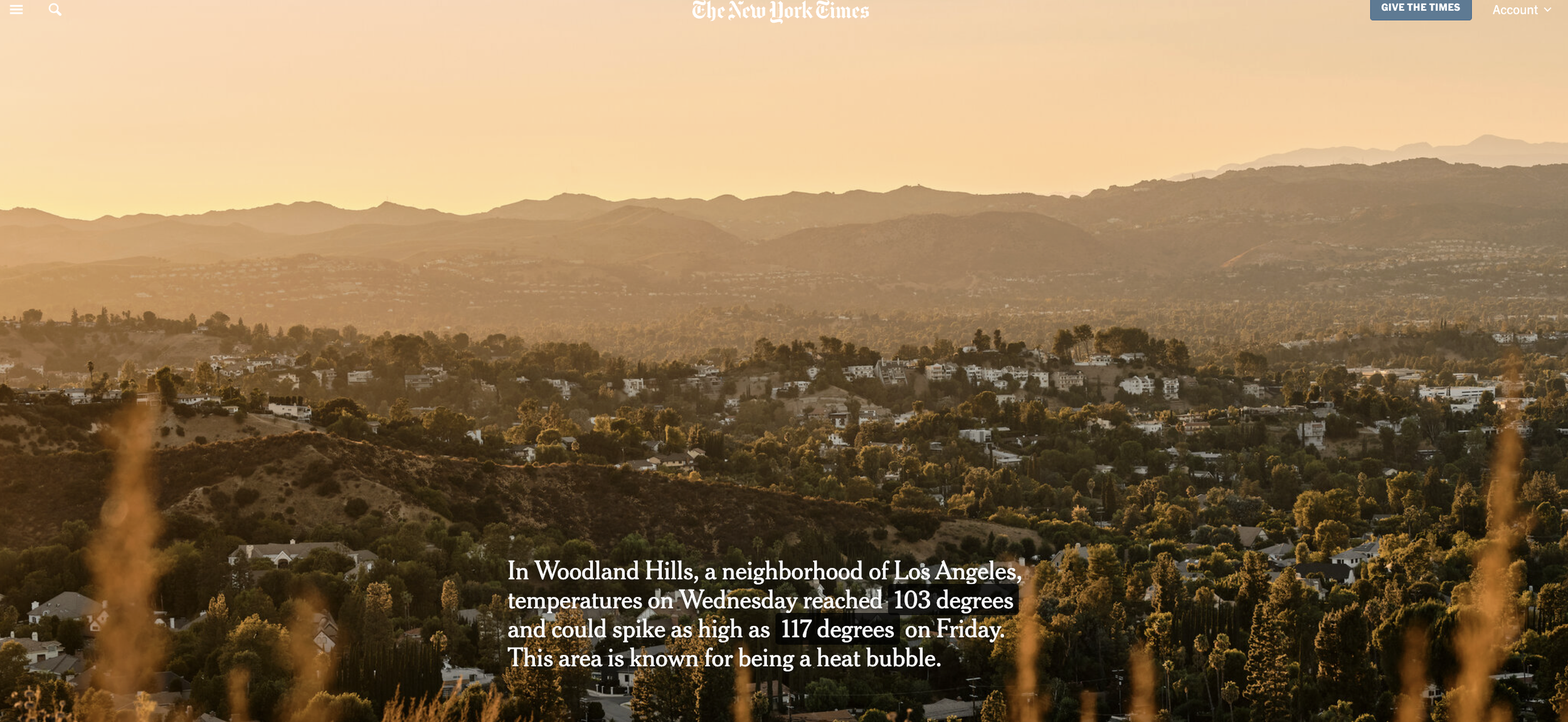
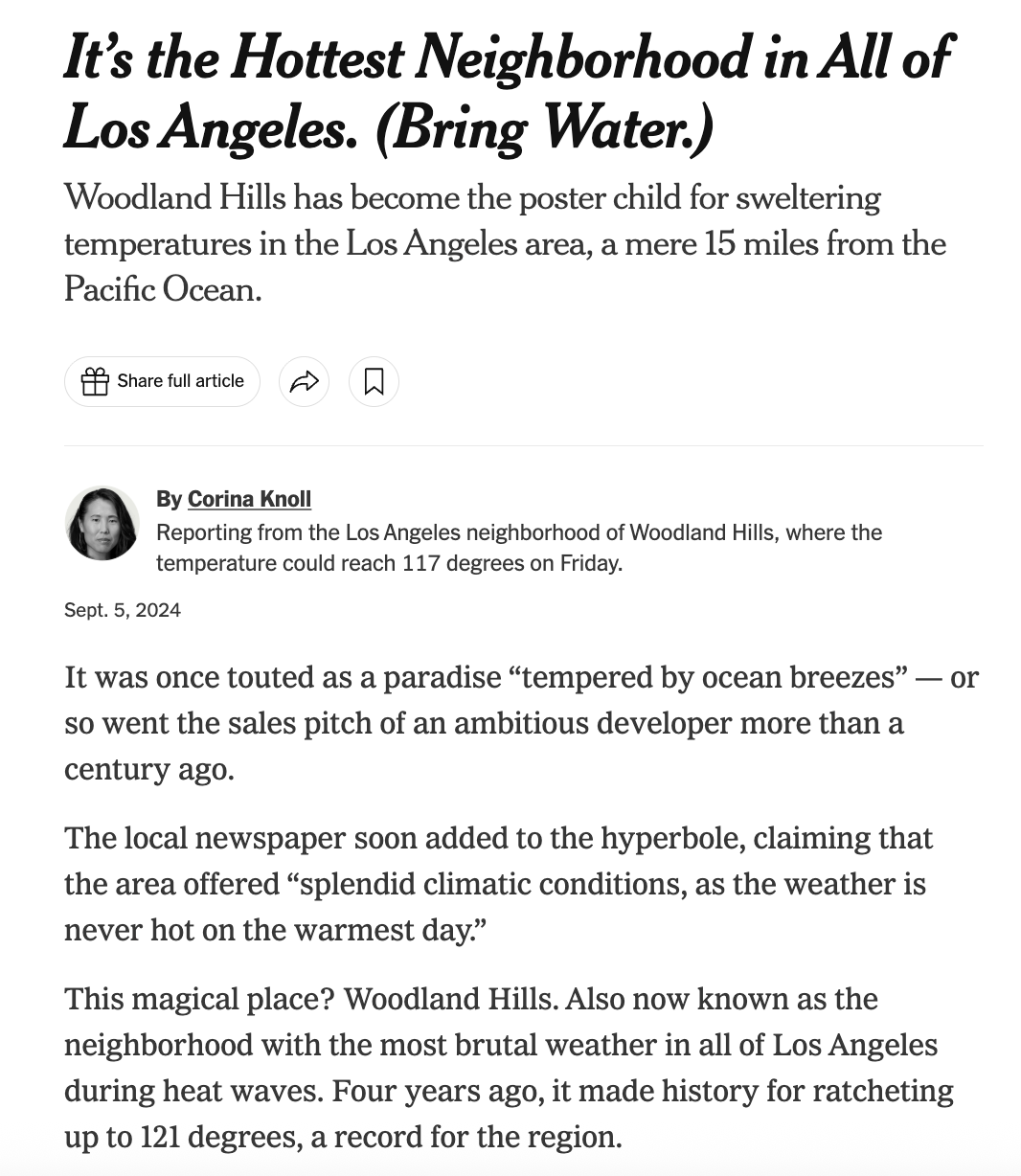
Read the full piece from September 2024 here : https://www.nytimes.com/2024/09/05/us/woodland-hills-los-angeles-heat-wave.html
Preview:
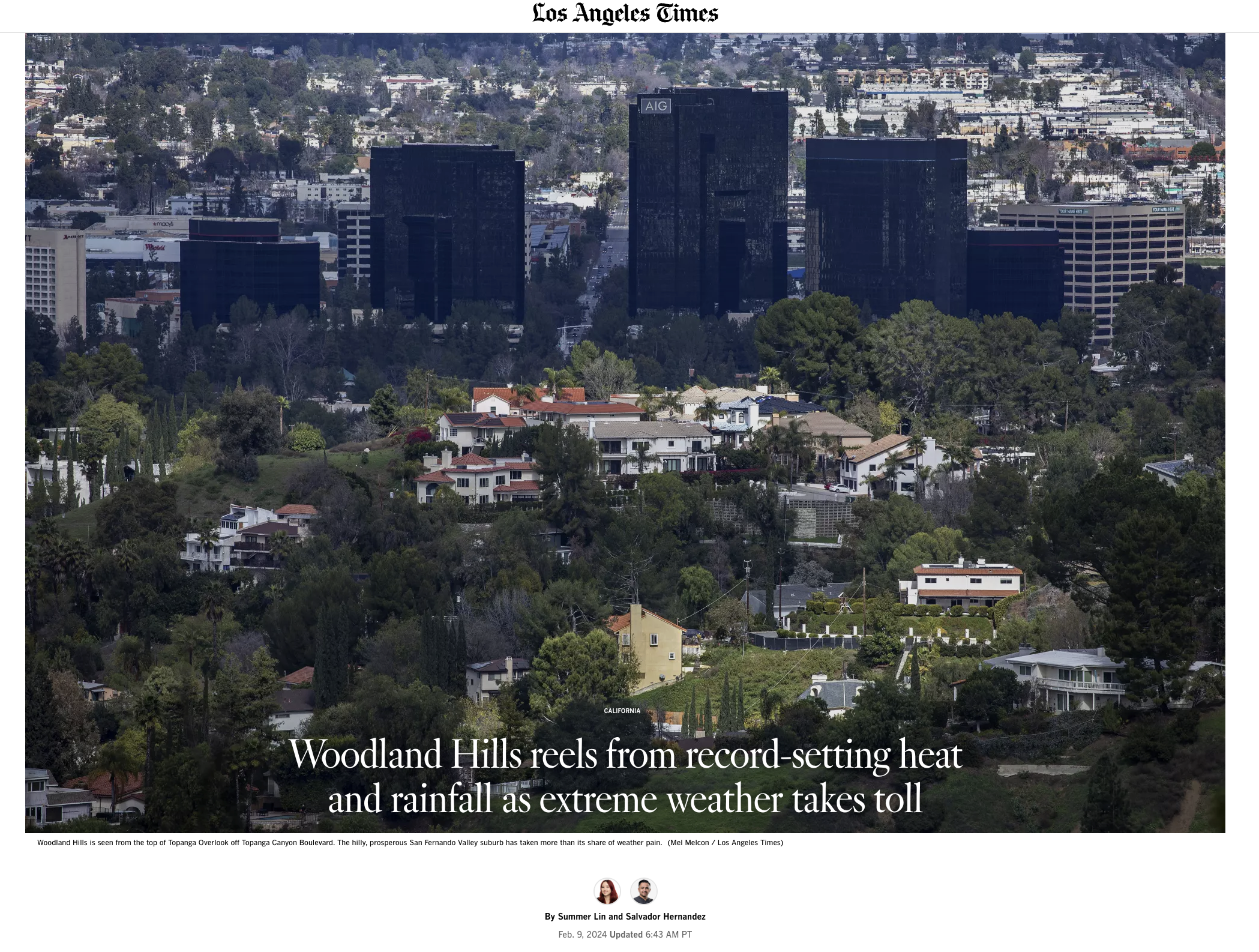
Read the full piece from February 2024 here :
Highlights:
Climate change in particular has made extreme weather events even more severe over time, according to Daniel Swain, a climate scientist at UCLA.
“We don’t have to go very far back in time to see we had one of the driest seasons on record recently,” Swain said. “But then last year was really wet, and this year was super wet. So we’re experiencing extreme drought and now we’ve experienced extreme precipitation in the last decade.”
Nestled in the San Fernando Valley next to the Santa Monica Mountains, this quiet L.A. neighborhood has always borne the brunt of some of the most extreme weather in Los Angeles County.
Regarding the rain
“It was scary, especially at night,” [resident] Brittany Stewart said. “People tend to speed and slam on the brakes and hydroplane. The streets get flooded, the freeways get flooded. I don’t know what we can do about that.”
What did Woodland Hills do to deserve this? As with property values, it’s all about location, location, location.
Why the extreme heat ?
Because the Santa Monica Mountains block the air blowing in directly from the ocean: the neighborhood is the last to receive the respite of a cool breeze during heat waves even though it’s near the ocean
Instead, marine air has to make its way up from the beaches through downtown, Glendale, Burbank and lastly into the western corner of the Valley under the Santa Monica Mountains to Woodland Hills.
“The ocean breeze is basically nature’s air conditioning,” said NWS forecaster Ryan Kittell, adding that for Woodland Hills, “it takes a lot longer for that AC to kick in.”
That cooling breeze also warms as it travels, sometimes leaving little respite by the time it reaches Woodland Hills, Kittell said. “Sometimes it doesn’t get there at all,” he said.
Why the extreme rain ?
But the region also sinks to freezing temperatures almost every year during the winter. It hit 18 degrees, tied for its record low, in 1989, according to the National Oceanic and Atmospheric Administration.
Like most storms in Southern California, this week’s system traveled from north to south. But in order for that moisture to turn into rain, it has to cool down first. That’s where the mountains, stretching from east to west perpendicular to the storm, come in.
“It’s like a ramp,” Kittell said. “If the winds are blowing from south to north, they go to Malibu and just go up.”
As that moisture rises, cools and turns into rain, it deluges Woodland Hills, which is located in the foothills.